
Chapters
Although Romania is a member of the European Union, the official Romanian currency is the Romanian leu (plural: lei), with the international currency code RON. Romania has not adopted the euro yet, so all transactions across the country are made in lei.
One important detail to know about Romanian currency is that the leu is not widely traded outside the country. In most cases, you cannot buy Romanian leu abroad. If you want to exchange foreign currency into Romanian currency, it is best to do so locally, either at a bank or at an authorized exchange office displaying 0% commission. Exchange offices located at airports or near railway stations usually offer less favorable rates.
If you’re planning your trip, it’s a good idea to check the current mid-market exchange rate before departure. Use a reliable currency converter to see how much your home currency equals in Romania leu. Being informed helps you avoid poor exchange deals and better manage your travel budget.
A Short History of the Romanian Currency
The Romanian leu has been the official money in Romania since 1867. Over time, the country went through several monetary reforms, especially during and after the communist period.
In 2005, Romania carried out a major currency redenomination to stabilize the economy. Four zeros were removed from the old leu. This means that 10,000 old lei became 1 new leu (RON). Since then, the Romania leu has remained relatively stable.
An interesting feature of modern Romanian currency is that banknotes are made from polymer (plastic), not paper. Romania was one of the first countries in Europe to adopt polymer notes. They are durable, waterproof, and much harder to counterfeit.
Money in Romania: Banknotes and Coins
Curious about what’s in your wallet if you’re spending a day in Bucharest or searching for the famed Bran Castle? These days, Romanian currency—the leu (plural: lei)—has taken on a more compact form. A single leu is sliced into 100 bani, and if you’re keeping track, here’s how the current denominations shake out:
- Banknotes: You’ll typically encounter 1, 5, 10, 50, and 100 lei bills in daily transactions. For those who like to collect, there are also 20, 200 and 500 lei notes, though these are a rare sight outside of a bank vault or the occasional enthusiastic souvenir shop.
- Coins (Bani): Jangling in local pockets, you’ll find coins valued at 1, 5, 10, and 50 bani.
So, next time you’re counting your change at a Transylvanian café, you’ll know exactly what to expect.
This is how Romanian currency looks:
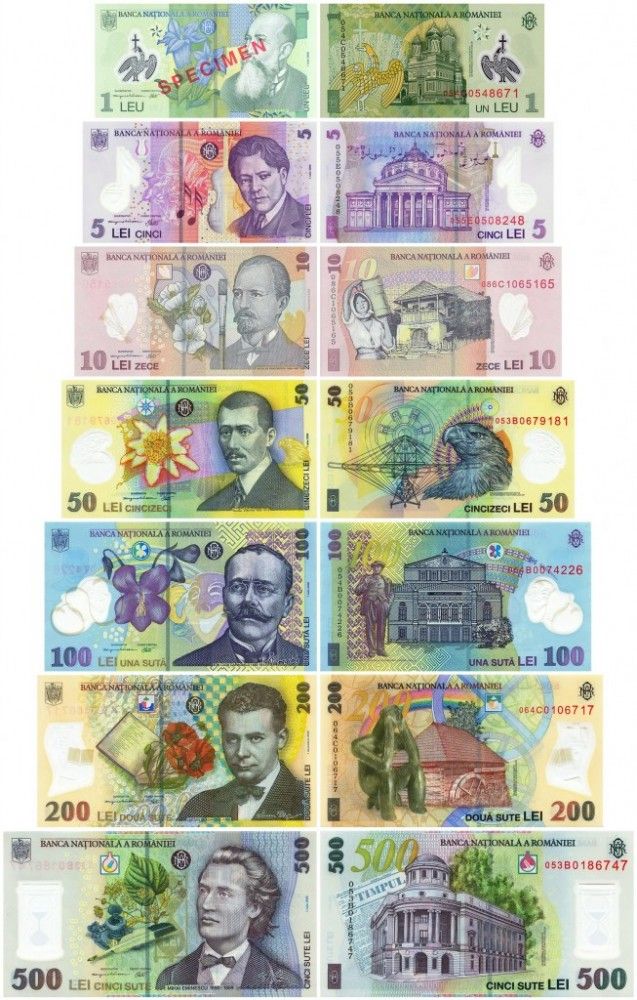
Photo by World Paper Money Catalog and History
How Romanian Currency Looks: Banknote Designs
The face of the 1 Romania leu bill features the portrait of Romanian historian Nicolae Iorga. On the back, there’s the Episcopal Cathedral of Curtea de Argeş Monastery and the ancient Wallachian coat of arms, featuring an eagle holding a cross in its beak.
The face of the 5 Romania lei bill features the portrait of Romanian violinist and composer George Enescu. On the back, there’s the Romanian Athenaeum, one of Bucharest’s symbol buildings, a piano, and a musical stave.
The face of the 10 Romania lei bill features the portrait of Nicolae Grigorescu, one of the founders of Romania’s modern painting school. On the back, there is a traditional house from the Oltenia region ( named „culă”) and a fragment of Grigorescu’s painting.
The face of the 20 Romanian lei banknote features the portrait of aviator Ecaterina Teodoroiu, a heroine of the First World War and the first woman to appear on a Romanian banknote. Known for her courage on the battlefield, she became a symbol of bravery and patriotism after fighting alongside soldiers and losing her life in 1917. On the reverse side, the banknote depicts the Mausoleum of Mărășești, a monument dedicated to the heroes who fell during the First World War, along with symbolic military elements that reflect her role in Romania’s history.
The face of the 50 Romania lei bill features the portrait of pioneer airplane builder Aurel Vlaicu. On the back, there is a sketch of Vlaicu’s second airplane, an airplane engine section sketch, and an eagle’s head.
The 100 Romania lei bill features the portrait of Romania’s most famous playwright, Ion Luca Caragiale, on its face, and on the back is the old National Theatre of Bucharest.
The face of the 200 Romanoa lei bill features the portrait of Romanian poet Lucian Blaga and on the back there is the Neolithic statue “The Thinker of Hamangia”, one of the oldest artifacts found in Romania, along with a rainbow and an old water mill.
The face of the 500 Romania lei bill features the portrait of Romania’s national poet, Mihai Eminescu, and on the back, there is the University Library in Iasi and a page from Timpul newspaper, which Eminescu once ran.
Interesting facts about the Romanian currency
1. The 5.000.000 lei bill from 1947, which appeared in the context of severe inflation after World War II, has the highest nominal value in the Romanian Leu history. The second Romanian bill recognized by Guinness World Records was the 1.000.000 lei bill from 2003.
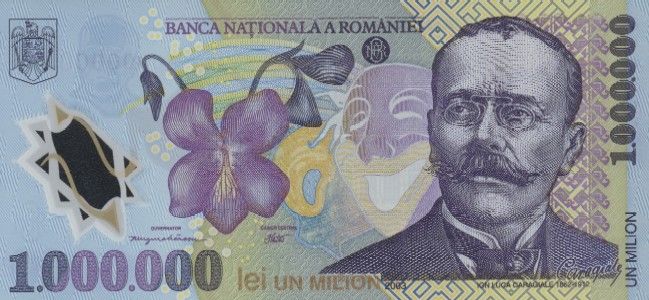
Photo by InCont.ro
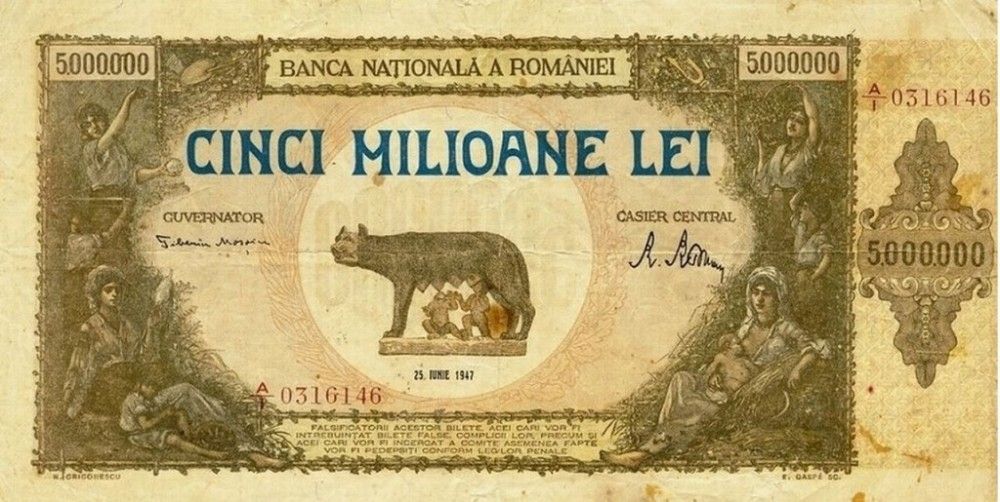
Photo by InCont.ro
2. In 1999 was made the 2000 lei bill to commemorate the total solar eclipse visible over Romania in that year. On the back is a map of Romania with the eclipse path.
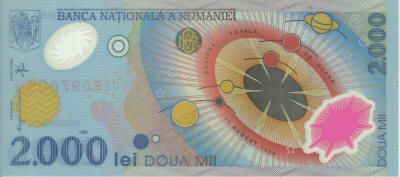
Photo by World Paper Money Catalog and History
Good to Know about Romanian Currency before Traveling to Romania
Can You Use Euros in Romania?
While the euro is a familiar sight across much of Europe, Romania still uses the leu (RON) as its official currency. Most shops, restaurants, and services in Bucharest and throughout the country do not accept euros. You might find a few hotels or large international chains willing to take euros, but in general, daily transactions require lei.
If you arrive in Romania with euros (or other foreign currency), don’t worry—you’ll find banks and exchange offices throughout the city where you can convert your money. Just remember that using local currency will simplify everything from taxis to buying a coffee.
Comparing Romania Leu Exchange Rates Before Your Trip
Before you travel, it’s a good idea to shop around and compare current Romania leu exchange rates to get the most value for your money. You can check the latest rates online using reputable sources like XE, OANDA, or investing.com, which frequently update their currency calculators and charts. Many banks and currency exchange offices also publish their daily rates on their websites—this allows you to gauge which provider offers the best deal.
For the most accurate comparison, consider checking:
- Official bank websites for posted rates (major Romanian banks such as Banca Transilvania or BRD are a good starting point)
- Currency converters or financial news outlets for real-time exchange rates
- The rates offered at local exchange offices when you arrive in Romania, as these sometimes differ from those found online
Take a few moments to research before exchanging, and avoid making swaps at the airport or rail stations, where the rates are typically less favorable. This extra step can help you stretch your budget further during your Romanian adventure.
Is Cash Still Necessary in Romania?
While most shops, restaurants, and hotels in Romania’s cities and larger towns accept credit and debit cards (think Mastercard or Visa), carrying some cash is still a smart idea—especially if you plan to venture beyond urban centers.
You’ll find cash particularly handy for:
- Rural villages or markets, where card payment is rare
- Small purchases, like bus tickets, coffee, or snacks at local kiosks
- Certain taxis—especially if you’re hailing one off the street rather than using an app
- Occasional entrance fees at churches, museums, or nature spots
Even in the age of contactless payments, a few crisp bills in your pocket ensure you never find yourself unable to buy a treat at a countryside bakery or tip the charming guide at a centuries-old church.
Are ATMs widely available in Romania?
Yes, ATMs are easy to find throughout Romanian towns and cities. Most urban areas have an abundance of cash machines, and you’ll spot them at shopping centers, banks like BCR and BRD, and even outside convenience stores or main squares. Many operate around the clock for added convenience. If you’re venturing into rural areas, plan to withdraw cash ahead of time, as access can be less frequent outside the larger towns.
Credit and Debit Card Usage in Romania
You’ll find that credit and debit cards (Visa, Mastercard, American Express) are widely accepted throughout Romanian cities and larger towns—hotels, restaurants, supermarkets, and even many taxis make card payments a breeze. However, it’s a good idea to keep some cash handy, especially when venturing into villages, outdoor markets, or remote areas where card terminals are as rare as a sunny February in Bucharest. Some small businesses still prefer the clink of coins over the beep of a card reader, so a mix of card and cash will keep you prepared for any situation.
Should You Pay in Lei or Your Home Currency at ATMs?
When using ATMs in Romania, you might notice that many machines kindly offer to charge you in your home currency rather than in lei. While this might sound convenient (and even a little tempting after a long flight), it’s actually best to stick to the local currency—lei—when withdrawing cash.
Opting for your home currency often means you’ll be subject to unfavorable exchange rates and extra fees set by the ATM provider, not your own bank back home. In short, always choose to be charged in lei. This way, you’ll get a more competitive exchange rate and avoid unnecessary additional costs.
Paying in local currency is a simple way to ensure you’re not giving away money for nothing. And as with exchanging cash, using bank-affiliated ATMs generally gets you better value than standalone machines at airports or tourist hot spots.
Final Thoughts on Romanian Currency
Understanding Romanian currency before arriving in the country makes your trip smoother and more budget-friendly. The Romania leu is stable, easy to use, and supported by modern banking infrastructure.
Whether you are paying for a museum ticket in Bucharest, buying handmade crafts in Maramureș, or enjoying dinner in Transylvania, knowing how money in Romania works helps you travel confidently.
Related Trips

Tours from Bucharest
Shared Tours
Tours from Bucharest
Shared Tours

Tours from Bucharest
Shared Tours

Tours from Budapest
Private Tours
Other articles

For a first visit, plan at least 5–7 days to…

The best time to visit Romania is late spring (May–June)…

A practical guide to airports in Romania: main international airports,…

Romania is not an easy country to explain in a…

Romania is a country where medieval citadels rise above cobbled…

Tired of overtourism in Europe? Romania offers the culture, landscapes,…